

Aug
Russell Westbrook Retirement: The Records, Moments and Legacy That Defined an 18-Year NBA Career
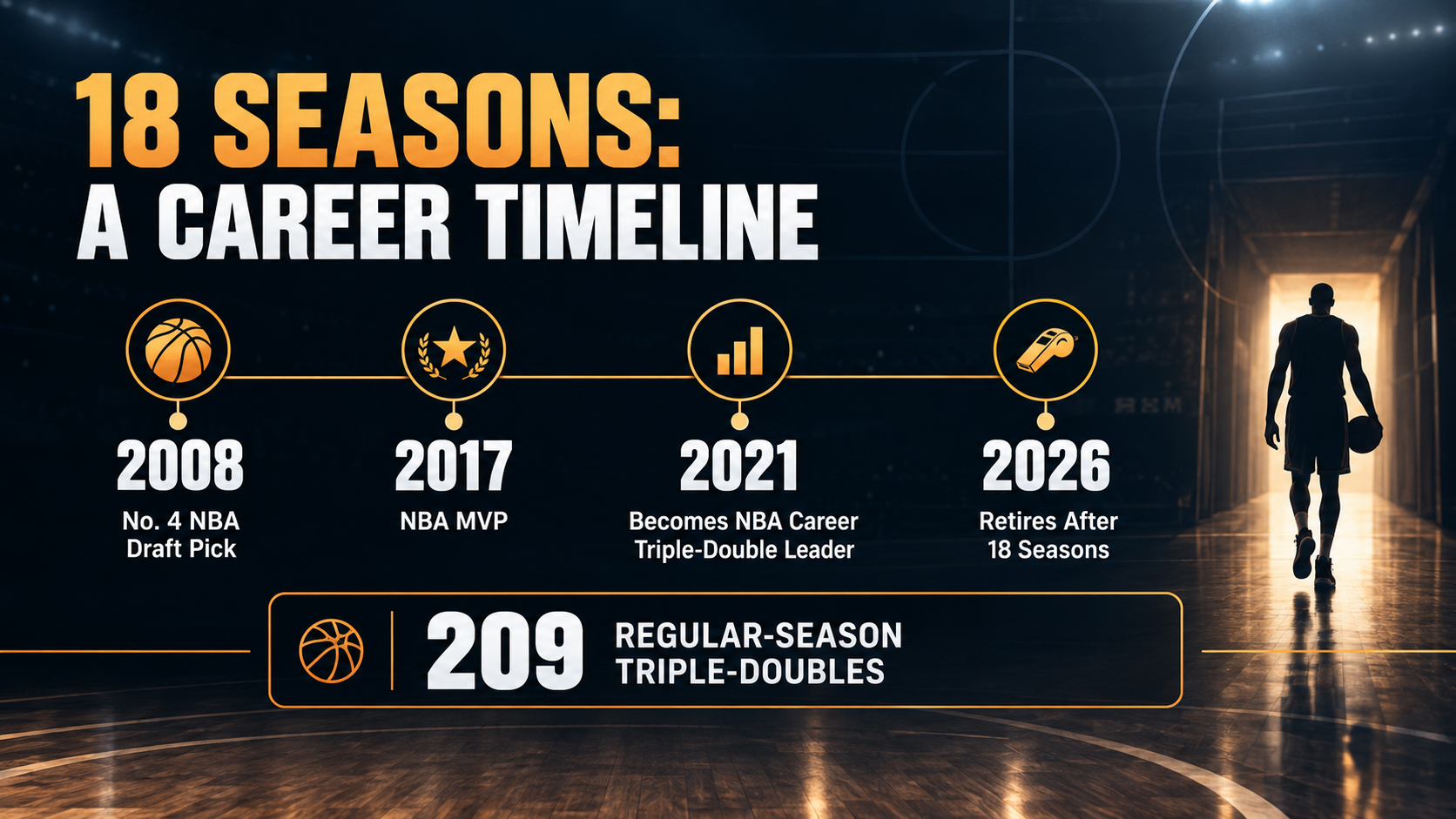
The Russell Westbrook retirement closes an NBA career that lasted 18 seasons and produced numbers few guards have approached. Westbrook announced his retirement on August 12, 2026, leaving as the NBA’s all-time regular-season triple-double leader with 209, a former league MVP and one of the most statistically distinctive guards of his era.
The raw totals tell only part of the story. Westbrook changed expectations around what a point guard could contribute as a scorer, passer and rebounder, while his aggressive style made him one of basketball’s most recognizable competitors.
Table of Contents
- What happened
- Russell Westbrook retirement: key facts
- The numbers that defined his career
- Three moments that explain his legacy
- Why Westbrook’s career matters
- Where his legacy fits
- What happens next
- FAQ
- Sources
What Happened?
Russell Westbrook announced his retirement from the NBA on August 12, 2026, after completing 18 seasons.
NBA.com confirmed that Westbrook finished his career as the league’s all-time leader in regular-season triple-doubles, ranked fifth on the NBA’s career assists list and 14th in career points at the time of his retirement.
His retirement announcement was delivered through a social media video narrated by actor Michael B. Jordan.
Westbrook entered the NBA as the fourth overall pick in the 2008 NBA Draft. He ultimately played across seven franchises, with his final season coming for the Sacramento Kings.
The retirement ends one chapter, but it also changes the way Westbrook’s career will be discussed. Instead of asking what he can still produce on a basketball court, the conversation now becomes historical: where does his résumé belong among the most influential guards of his generation?
Russell Westbrook Retirement: Key Confirmed Facts
Here is the essential verified snapshot of Westbrook’s career:
| Career fact | Verified figure |
|---|---|
| NBA seasons | 18 |
| Regular-season games | 1,301 |
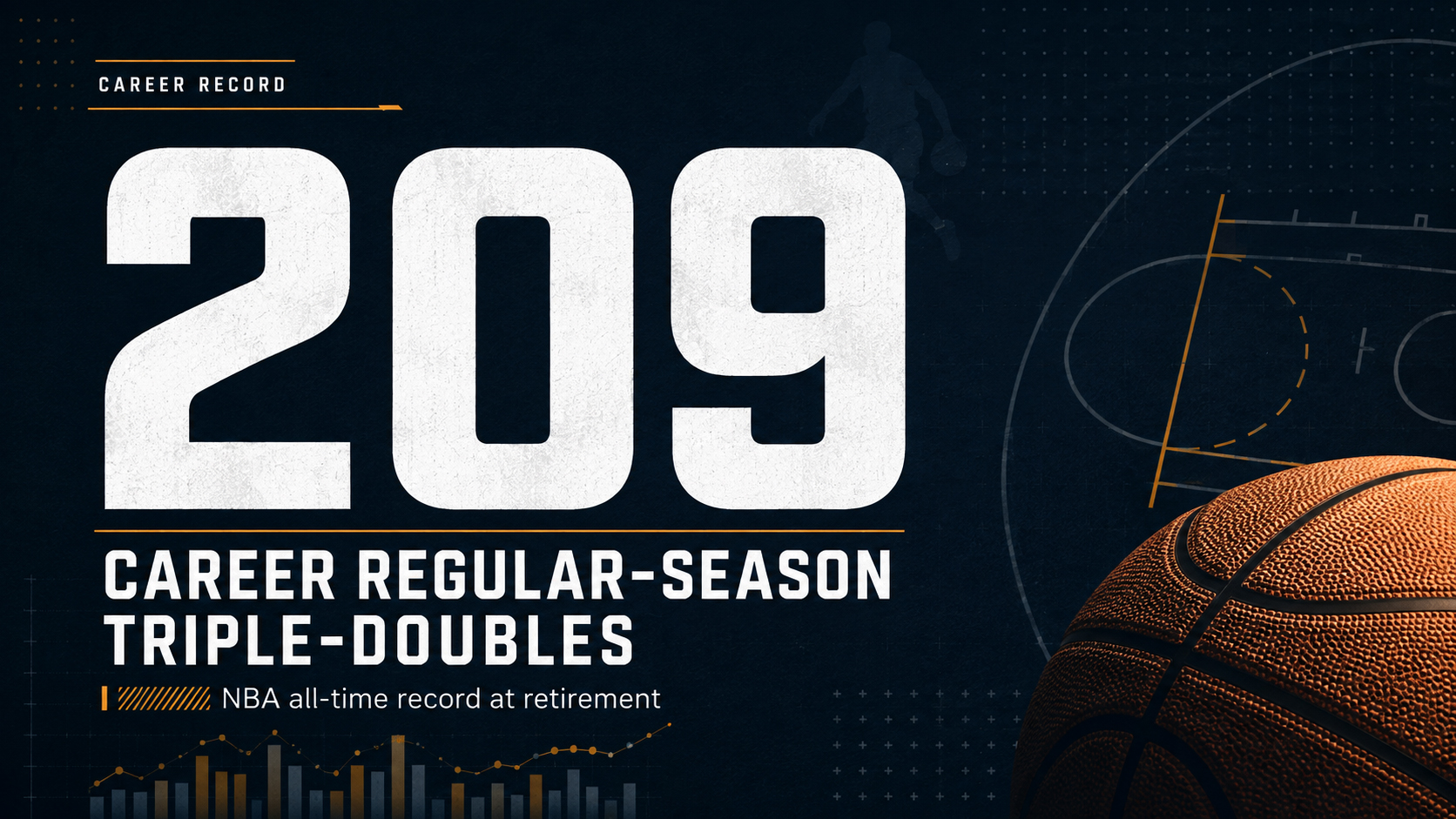
| Career triple-doubles | 209 |
| Career scoring rank at retirement | 14th |
| Career assists rank at retirement | 5th |
| NBA MVP awards | 1 |
| NBA All-Star selections | 9 |
| All-NBA selections | 9 |
| Career scoring average | 20.9 PPG |
| Career assists average | 8.0 APG |
| Career rebounds average | 6.9 RPG |
| Draft position | No. 4 in 2008 |
NBA.com also lists Westbrook as a two-time NBA All-Star Game MVP and an Olympic gold medalist.
Those numbers give the Russell Westbrook retirement unusual historical weight. Few players finish near the top of multiple major career categories while also holding one of the league’s best-known individual records.
The Numbers That Defined the Russell Westbrook Career
209 regular-season triple-doubles
The statistic most closely associated with Westbrook is the triple-double.
He retires with 209 regular-season triple-doubles, the NBA record.
Westbrook took sole possession of the career record on May 10, 2021, when he recorded the 182nd triple-double of his career and passed Oscar Robertson’s previous mark of 181.
Robertson’s record had stood since 1974.
That historical context matters. Westbrook did not merely add a few performances to an existing standard. He overtook a record that had survived multiple generations of NBA basketball and eventually pushed the total well beyond the previous mark.
42 triple-doubles in one season
The 2016-17 season became the statistical centerpiece of Westbrook’s career.
He recorded 42 triple-doubles, breaking Robertson’s previous single-season record of 41.
The record-breaking 42nd came against Denver on April 9, 2017. Westbrook finished that game with 50 points, 16 rebounds and 10 assists, while also making the game-winning shot.
It remains one of the clearest examples of why his MVP season became such a major part of his basketball identity.
A season-long triple-double average
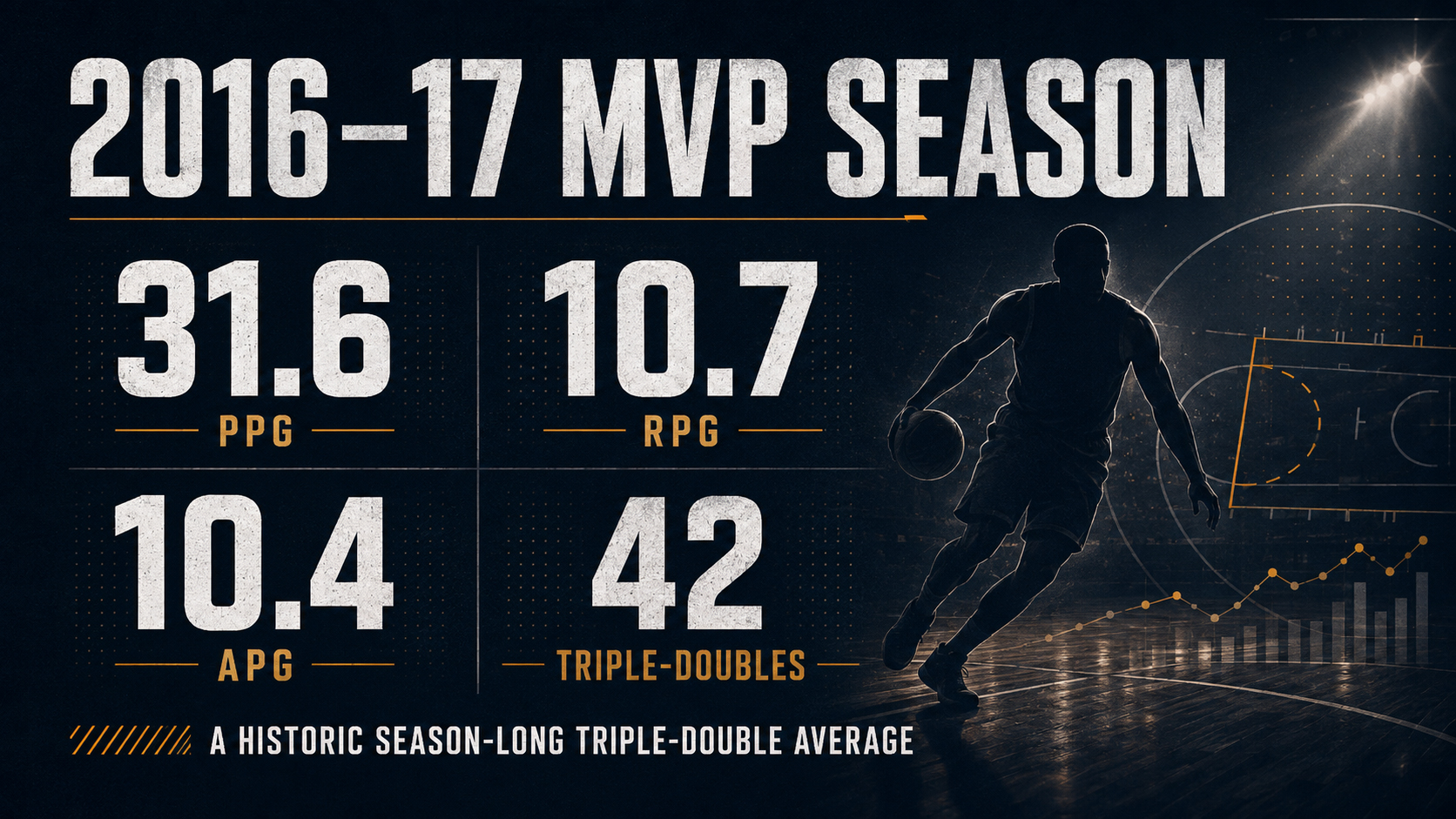
Westbrook finished the 2016-17 regular season averaging:
- 31.6 points
- 10.7 rebounds
- 10.4 assists
He became the first NBA player since Robertson in 1961-62 to average a triple-double for an entire season.
Westbrook then accomplished a season-long triple-double average three more times — in 2017-18, 2018-19 and 2020-21.
That repetition is important when evaluating his legacy. The first season demonstrated that the feat could still happen in modern basketball. The seasons that followed showed that it was not simply a one-year statistical anomaly.
Three Moments That Help Explain the Russell Westbrook Legacy
Statistics provide the framework of Westbrook’s career, but three moments are especially useful for understanding why his résumé stands out.
1. The 2016-17 MVP season
Westbrook’s first full season after Kevin Durant left Oklahoma City became his defining individual campaign.
He averaged 31.6 points, 10.7 rebounds and 10.4 assists, set the single-season triple-double record with 42 and won the 2016-17 NBA MVP award.
The season became bigger than a collection of box scores. It helped restore the triple-double to the center of basketball discussion decades after Robertson’s famous 1961-62 season.
2. Breaking Oscar Robertson’s career record
By 2021, Westbrook was chasing a record once viewed as extraordinarily difficult to reach.
On May 10 of that year, he recorded career triple-double No. 182 against Atlanta, passing Robertson.
The significance was partly mathematical and partly historical. Robertson had held the mark for roughly 47 years.
Westbrook eventually extended the record to 209.
3. Finishing among the leaders in both points and assists
The triple-double record naturally dominates discussions of Westbrook, but focusing exclusively on it can obscure the breadth of his career.
At retirement, he ranked:
- 5th all-time in assists
- 14th all-time in points
That combination is particularly useful when evaluating longevity.
Westbrook was not simply a specialist who accumulated one unusual statistic. He created offense both by scoring and by setting up teammates at historically significant volumes.
Why the Russell Westbrook Retirement Matters
The most interesting part of the Russell Westbrook retirement may be what it reveals about how basketball changed during his career.
He expanded expectations for point guard production
Traditional point guards were often judged primarily by passing, ball security and running an offense.
Westbrook’s game was broader and more physically aggressive.
At his peak, possessions could begin with Westbrook grabbing a defensive rebound himself and immediately initiating the transition attack. That ability compressed several traditional basketball roles into one player.
That did not make his approach universally optimal, and his style generated legitimate basketball debates throughout his career. But it did make him unusually difficult to categorize using older definitions of the position.
He changed how fans viewed the triple-double
This may be his most significant statistical influence.
Before Westbrook’s peak, a triple-double often felt like a notable single-game event.
During his prime, fans began tracking triple-doubles as season-long totals, streaks and career records.
That is partly why Westbrook’s statistical legacy is more meaningful than simply saying he has 209 of them. His run changed the baseline against which extraordinary all-around production was discussed.
His career also illustrates why statistics need context
Westbrook is an interesting historical case because the same statistics that made him extraordinary also generated debate.
A triple-double measures production in at least three categories, but it does not automatically explain efficiency, defensive impact, lineup fit, postseason success or the circumstances in which the statistics occurred.
That does not invalidate Westbrook’s records.
Instead, it makes his career more valuable as a basketball discussion. The numbers are historic, while evaluating exactly what those numbers meant requires context.
That tension is likely to remain part of the Russell Westbrook legacy for years.
For readers interested in the broader evolution of stars and statistical milestones, see NBA player legacies and basketball history.
Original Analysis: What Makes Westbrook’s Legacy Different?
Westbrook’s legacy can be divided into two layers.
The first is objective.
The records exist regardless of anyone’s opinion: 209 regular-season triple-doubles, a record 42 in one season, an MVP award, nine All-Star selections and top-15 career positions in both points and assists.
The second layer is interpretive.
Westbrook played with a level of visible urgency that became central to how fans perceived him. He attacked transition opportunities quickly, rebounded aggressively for a guard and frequently placed enormous offensive responsibility on himself.
That style created spectacular peaks. It also invited criticism when the same aggression produced difficult shots, turnovers or poor offensive possessions.
Both sides belong in a serious legacy discussion.
Treating Westbrook only as a record-breaking hero would leave out important basketball context. Treating him only through his flaws would ignore a career whose production reached historic levels.
The more useful conclusion is that Westbrook was an unusually consequential player because his strengths were extreme enough to change games, statistical records and basketball conversations.
The 2016-17 season may remain the best single snapshot
If a future fan wanted one season to understand Russell Westbrook, 2016-17 would be the logical place to begin.
It contains nearly every defining feature of his career:
- High-volume scoring
- Elite playmaking
- Exceptional rebounding for a guard
- Historic triple-double production
- Late-game aggression
- An MVP award
- Constant debate about how individual production should be evaluated
In that sense, his MVP season is more than his best collection of numbers. It is a compact version of the questions that followed Westbrook for much of his career.
A Commercial Site Should Keep Editorial Coverage Separate From Merchandise
A sports or POD website can cover the Russell Westbrook retirement as factual editorial content while keeping the commercial side clearly separated.
Reporting on an athlete’s career does not mean a retailer has permission to sell merchandise using that athlete’s name, likeness, team marks, league logos or other protected intellectual property.
A natural editorial-to-commerce path would instead move readers toward generic basketball content.
For example: personalized basketball gift ideas
and, where genuinely relevant: personalized basketball apparel
Those destinations should contain original, generic basketball designs rather than products implying an official connection with Westbrook, the NBA or one of his teams.
This keeps the article useful for sports readers without turning a news event into an unauthorized merchandising claim.
What Happens Next?
Confirmed
Russell Westbrook has retired from NBA competition after 18 seasons.
That is the confirmed development.
Not confirmed
The verified sources reviewed for this article do not establish a specific post-playing role for Westbrook.
It would therefore be premature to state that he will become a coach, broadcaster, executive or take another basketball position unless Westbrook or a reliable source confirms such plans.
Similarly, future ceremonies, honors or other post-retirement events should be reported only when officially announced.
What can reasonably be expected is continued discussion of his historical standing. His career statistics now have a final total, allowing comparisons with other guards to shift from projections to a completed résumé.
Frequently Asked Questions
When did Russell Westbrook retire?
Russell Westbrook announced his retirement on August 12, 2026, following an 18-season NBA career.
How many triple-doubles did Russell Westbrook have?
Westbrook finished with 209 regular-season triple-doubles, the NBA career record at the time of his retirement.
He first took possession of the all-time record in May 2021 when he passed Oscar Robertson’s total of 181.
How many seasons did Russell Westbrook play in the NBA?
Westbrook played 18 NBA seasons after being selected fourth overall in the 2008 NBA Draft.
What was Russell Westbrook’s best statistical season?
His 2016-17 MVP season is his clearest statistical peak. He averaged 31.6 points, 10.7 rebounds and 10.4 assists while setting the then-record of 42 triple-doubles in one season.
Conclusion
The Russell Westbrook retirement ends one of the NBA’s most statistically remarkable modern careers.
His final résumé includes an MVP award, nine All-Star selections, 209 regular-season triple-doubles, the single-season triple-double record and career rankings near the top of both the NBA’s scoring and assists lists.
But the most useful way to remember Westbrook is not simply through one number.
His career pushed basketball fans to reconsider what all-around production from a point guard could look like — and also sparked a long-running debate about how statistics, efficiency, winning and individual responsibility should be weighed against one another.
That debate will continue. The playing career behind it is now complete.
Sources
NBA.com — Russell Westbrook retirement announcement: confirmation of his August 12, 2026 retirement, 18 seasons, career averages, MVP season, nine All-Star selections and historical rankings.
NBA.com — Russell Westbrook: 18 Numbers to Know Upon Retirement: career statistical context and records.
NBA.com — Most Triple-Doubles in NBA History: 209 career regular-season triple-doubles and the history of Westbrook passing Oscar Robertson.
Reuters — Triple-double king Russell Westbrook announces retirement: independent confirmation of the retirement and major career accomplishments.
